
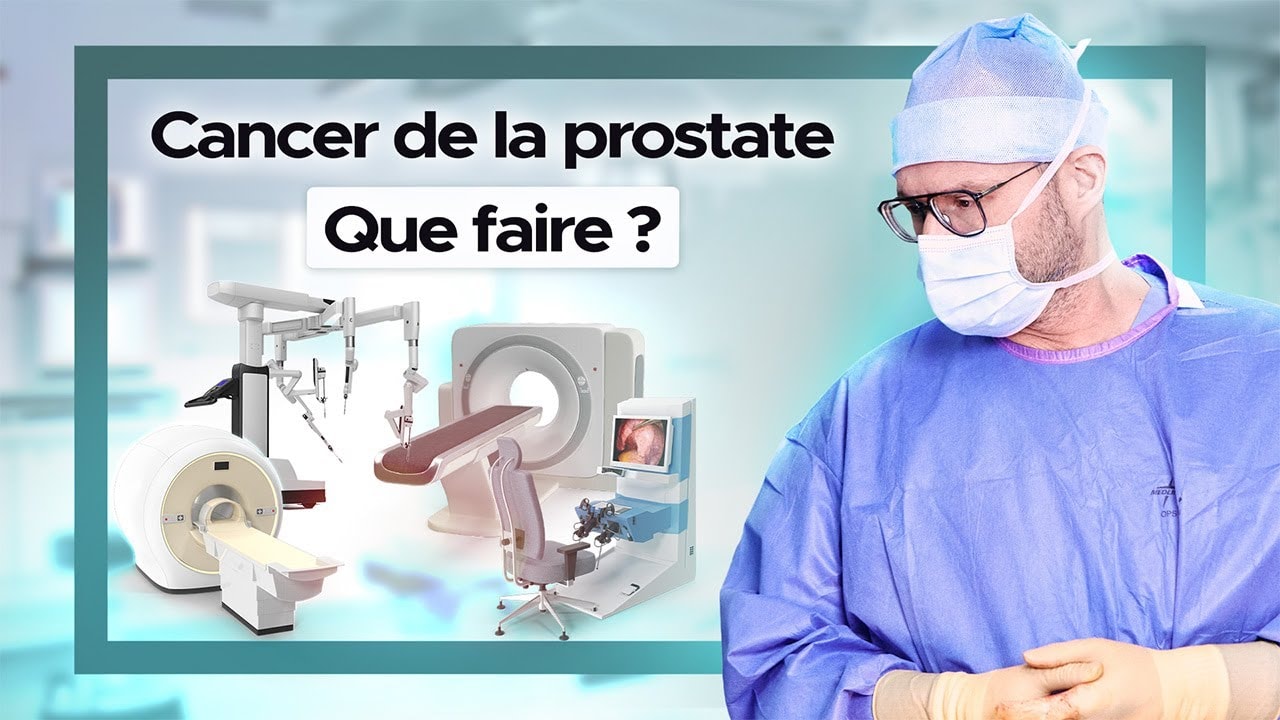
Receiving a prostate cancer diagnosis is always a difficult time. The first question that naturally comes to mind is simple: what should I do now?
The answer is not the same for everyone. Today, prostate cancers are no longer treated systematically in the same way. Decisions are made based on the stage of the cancer , its risk level , but also on the individual patient.
Before treating cancer, you must treat a patient who has cancer . This distinction is essential, as it completely changes how you approach the options.
The starting point: personalizing the decision
Treatment is never decided solely on a biopsy result or a PSA level. Many personal factors must also be taken into account:
- medical history,
- any potential comorbidities,
- lifestyle,
- sexuality,
- a possible desire for future fatherhood.
The final decision always rests with the patient, after they have received clear information about the available options. The urologist's role is to explain the realistic choices, their benefits, limitations, and potential consequences.
It's also important to keep in mind one key idea: the primary goal is to treat the cancer . The real enemy is the disease, not the treatment. Many men fear the side effects of treatment more than the cancer itself. This concern is understandable, but it shouldn't distract from the main objective.
Of course, future quality of life remains a central point. When considering treatment, particular attention is paid to:
- urinary continence ,
- the preservation of erections ,
- the overall balance between oncological effectiveness and quality of life.
Why the stage of cancer changes everything
The treatment of prostate cancer relies on very precise staging guidelines. These allow for a strategy tailored to the cancer's risk level.
These guidelines are used in a standardized way in France, in Europe and more broadly internationally. The objective is the same everywhere: to match the right treatment to the right stage .
Among the classifications used, we find in particular that of D'Amico , which makes it possible to distinguish between cancers with low risk, intermediate risk and high risk of progression or recurrence.
Low-risk prostate cancer: active surveillance is often the best option
When it comes to low-risk prostate cancer , the most common management today is active surveillance .
In other words, we are not rushing into immediate treatment. This is not inaction, nor is it abandonment. It is a rigorous medical strategy that consists of closely monitoring the progression of the disease.
What does active surveillance consist of?
It relies on close monitoring including:
- the clinical examination,
- PSA testing,
- If necessary, an MRI of the prostate .
- and sometimes further prostate biopsies .
The idea is simple: to avoid unnecessary treatment in patients whose cancer is progressing slowly or only slightly, while retaining the possibility of intervening quickly if the situation changes.
What if the patient does not wish to simply be monitored?
Some men find it difficult to accept the idea of having cancer monitored, even when it is slow-growing. In this case, it is possible to discuss conventional curative treatment , such as:
- surgery ,
- radiotherapy ,
- or sometimes focal treatment .
Focal treatment may be considered in certain well-selected cases, depending in particular on age and the low-aggressive nature of the tumor.
Intermediate-risk prostate cancer: treatment is necessary
When cancer is classified as intermediate risk , treatment is necessary. It is no longer simply a matter of routine monitoring.
Several options can then be offered.
Surgery: Prostatectomy
The surgical treatment is prostatectomy , that is, the removal of the prostate. This surgery has evolved considerably over the last fifteen years, particularly with the development of robotic surgery .
Robot-assisted prostatectomy , particularly with theDa Vinci robot, allows for more precise dissection. This precision is important for two reasons:
- to best preserve the urinary sphincters , in order to promote continence,
- preserve the nerves of the erection , in order to limit the impact on sexual function when possible.
It is never advisable to promise the same result for everyone, as it depends on the type of cancer, the anatomy, the age, and the pre-operative situation. However, advances in surgical techniques have clearly improved the precision of the procedure.
Radiotherapy
Radiation therapy is another curative treatment option. It may be offered:
- as a first intention ,
- or after surgery in certain situations.
The choice between surgery and radiotherapy depends on the patient's profile, the characteristics of the cancer, and the therapeutic objectives chosen.
Focal treatment and, in rare cases, active monitoring
In some patients, focal treatment may also be considered. In a few very specific situations and within the context of studies, active surveillance may sometimes remain a possibility, but this is limited.
High-risk prostate cancer: essential treatment, often combined
High-risk prostate cancers must be treated. At this stage, the goal is clearly to achieve the best possible control of the disease.
At a minimum, the following must be put in place:
- either surgery ,
- either radiotherapy .
However, in many cases, due to the aggressiveness of the cancer, combination therapy will be necessary. The most commonly recommended regimen is:
- surgery ,
- then radiotherapy .
This strategy aims to strengthen the chances of local control and reduce the risk of recurrence when the disease presents more threatening characteristics.
A decision never made alone: the multidisciplinary consultation meeting
Once the strategy has been decided upon between the patient and their urologist, this decision is validated by a committee of experts . This is now an essential rule in cancer care.
Each case is presented at a multidisciplinary consultation meeting , often abbreviated as RCP .
Who is participating in this meeting?
In the case of prostate cancer, the following are generally found:
- several urologists ,
- oncologists ,
- radiation therapists ,
- radiologists ,
- and more broadly a panel of experts accustomed to these decisions.
The goal is not to add complexity, but rather to ensure a sound decision. The case data is compared to current reference data to determine the best course of action .
How to choose between treatments?
The right treatment isn't just the one that exists on paper. It's the one that's appropriate.
- at the cancer stage ,
- to his aggressiveness ,
- depending on the patient's age ,
- to his general state of health ,
- to his personal priorities.
The choice is therefore made at the intersection of two realities:
- medical logic,
- the patient's reality of life.
This is why there is no single universal answer to the question "What should I do?". However, there is a rigorous method for finding the most appropriate answer in each situation.
Key takeaways
- Prostate cancer is not always treated immediately.
- For low-risk forms, active surveillance is often the preferred option.
- For intermediate-risk forms, treatment is generally necessary, by prostatectomy , radiotherapy or sometimes focal therapy .
- For high-risk forms, treatment must be carried out without delay, often with a combined strategy.
- The decision must always take into account quality of life , including urinary continence and erectile function.
- Each case must be validated in a multidisciplinary consultation meeting .
A key idea for moving forward
When faced with a prostate cancer diagnosis, it's normal to feel afraid, hesitant, and lost among several options. But it's important to stay focused: today, there are well-defined, structured treatment strategies tailored to each individual situation .
The most important thing is to have clear information, to understand the level of risk of one's cancer, and to build the decision with one's urologist on solid foundations.
The ideal treatment is neither the most intensive nor the most invasive. It is the one that effectively treats the illness while respecting, as much as possible, the patient's life afterward.