
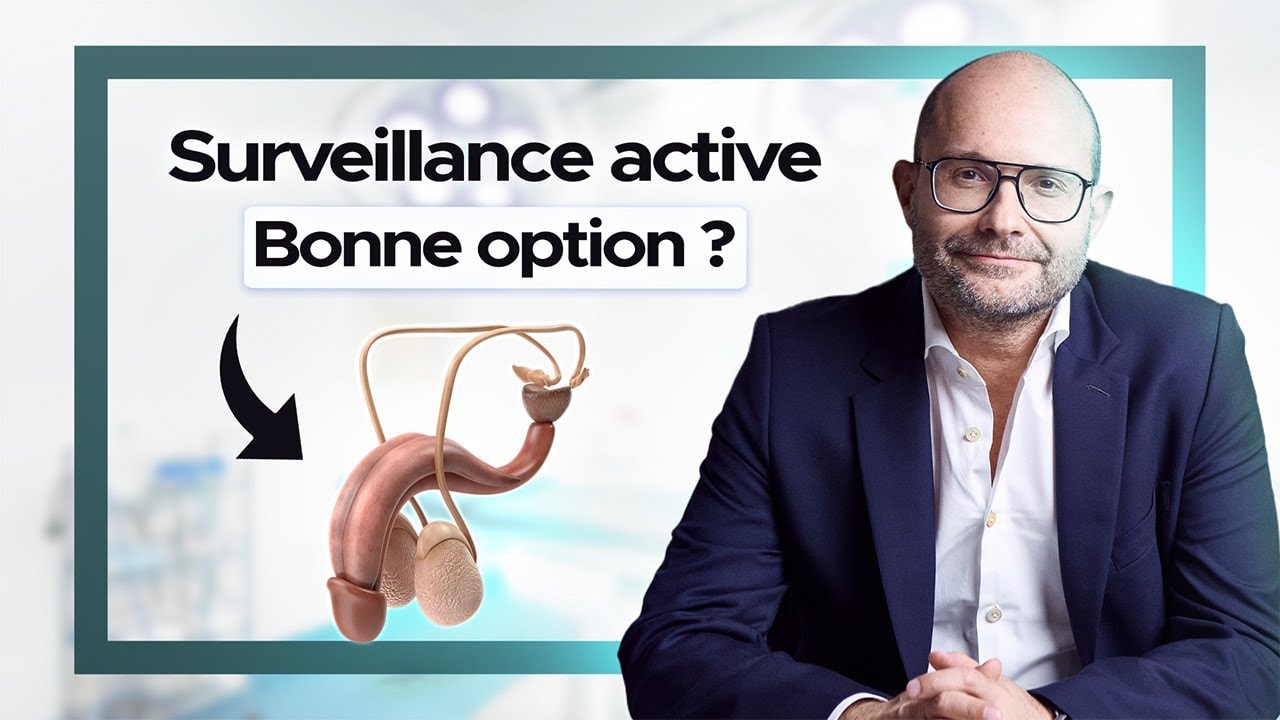
Receiving a prostate cancer diagnosis is always a shock. And when the urologist explains that he is not proposing immediate treatment, but active surveillance , many patients ask themselves the same question: aren't we taking a risk by waiting?
The answer is no, provided you are in a very specific situation and adhere to rigorous monitoring. Active surveillance is neither abandonment nor a passive attitude. It is a codified medical strategy designed to avoid unnecessary treatment while retaining the ability to intervene quickly if the disease progresses.
To fully understand this option, we need to go back to what a “micro-focal” of prostate cancer really is, who this strategy is for, and how the follow-up takes place in practice.
Why are more small prostate cancers being diagnosed today?
In recent years, the diagnosis of prostate cancer has evolved considerably. PSA screening from age 50, advances in prostate MRI , and the development of targeted prostate biopsies are making it possible to identify increasingly smaller lesions.
In other words, we are discovering more very localized, sometimes tiny, cancers that would probably have gone unnoticed a few years ago.
When a urologist speaks of a micro-foci , it means that there is a very small cancer in the prostate. The word is important: we are not talking about a large, aggressive, or already extensive tumor, but a minimal lesion, detected early.
This isn't to say that cancer "doesn't matter." If cancer exists, it's better to know about it. However, the modern goal is to avoid overtreatment .
The real challenge: avoiding overtreatment without losing the chance
Treatments for prostate cancer have progressed enormously. Surgery, particularly robot-assisted prostatectomy , and other curative approaches are more precise than before, with fewer side effects than in the past.
But let's be honest: side effects are never zero . Even if complications are less frequent and less pronounced, they still exist. If treatment can be avoided or delayed in a patient who doesn't immediately need it, that's preferable.
That's the crux of the matter:
- Do not treat a very slow-growing cancer too early .
- without letting the moment when it would be necessary to deal with it pass .
That's exactly the principle of active surveillance.
What is active surveillance?
Active surveillance involves not immediately treating prostate cancer considered to be low-grade, while implementing strict and repeated follow-up.
It's not a matter of "waiting and seeing". It's a structured approach with precise criteria, followed to the letter.
If the cancer remains stable, monitoring continues. If a sign of progression appears, active monitoring is immediately discontinued and curative treatment is offered.
The goal is therefore twofold:
- to preserve quality of life for as long as possible,
- intervene without delay if the disease profile changes.
In what cases is active monitoring indicated?
Active surveillance does not apply to all prostate cancers. It is aimed at so-called low-risk forms, particularly micro-foci.
The criteria mentioned are those of a cancer unlikely to progress or recur. In practice, this refers to patients presenting with:
- a PSA level below 10 ,
- a very small tumor ,
- and especially a Gleason score of 6 .
A Gleason score of 6 corresponds to a very low-grade form of prostate cancer. In this context, it is known that these tumors do not, on their own, have the ability to spread beyond the prostate, invade surrounding tissues, or even metastasize.
In other words, they are not dangerous if they are closely monitored .
Should we be afraid that cancer will develop?
This is the most frequently asked question, and it's a legitimate one.
When prostate cancer meets the criteria for a low-risk microfocus, active surveillance is precisely chosen because it is known that many of these cancers will not progress , or will progress very slowly .
An important point to remember is this: at 10 years, approximately 50% of patients with a true microfocal still do not need treatment .
This clearly shows that, in many cases, treating immediately would expose patients to side effects without any real short-term benefit.
However, this strategy is only reassuring if the monitoring is thorough. The security of active monitoring relies on the ability to quickly detect changes.
How does active surveillance work?
The protocol is simple in principle, but it must be followed rigorously.
The first year
After the diagnosis of prostate cancer and the decision to monitor, follow-up is usually done every 4 to 6 months during the first year.
At each consultation, we realize:
- a clinical examination , including a digital rectal examination,
- a PSA test .
These two elements already make it possible to identify a possible change in the disease profile.
One year post-op: the key milestone of prostate MRI
After a year, another MRI of the prostate is performed.
Two situations may then arise:
- If the MRI is identical to the one that enabled the diagnosis, it is not necessarily necessary to repeat biopsies.
- If the MRI has changed , further prostate biopsies must be performed.
MRI therefore plays an essential role in the reassessment of cancer.
Next: regular long-term monitoring
If everything remains stable, monitoring continues every 6 months with:
- a clinical examination,
- a PSA test.
Some teams also suggest repeating an MRI scan every 2 years .
The exact schedule may vary depending on the habits of the teams, but the idea remains the same: never allow a silent evolution to take hold.
What signs can lead to being removed from active surveillance?
Active monitoring continues only as long as the initial criteria remain valid.
The situation needs to be reconsidered if:
- The rectal examination changes ,
- PSA increases
- MRI becomes different ,
- or if biopsies show a change .
In this case, the diagnosis of microfocal tumor must be reviewed, and the stage and aggressiveness of the disease re-evaluated. If the cancer has progressed, the transition to curative treatment must be made quickly.
This is precisely what distinguishes active surveillance from simple waiting: we monitor in order to be able to act at the right time .
The main difficulty: the risk of under-staging
The most delicate point is not so much the monitoring itself as the initial assessment.
When diagnosing what is thought to be a micro-focal of prostate cancer, one question always remains: is it really a very small, slow-growing cancer, or an early-stage cancer that will gradually develop?
This is what is called the risk of understaging . In other words, we could initially underestimate the true extent of the disease.
This risk explains why monitoring must be active, methodical, and precise. The goal is precisely to quickly identify situations where the initial diagnosis was too optimistic.
If we were mistaken at first in thinking we were dealing with a micro-outbreak, close monitoring allows us to correct this assessment without delay.
Why this option can be a very good strategy
For patients who meet the right criteria, active surveillance is often an excellent option. It allows:
- to avoid being subjected to the constraints of treatment too early ,
- to limit exposure to side effects ,
- to preserve the quality of life ,
- while maintaining oncological safety through close monitoring.
The important message is therefore this: accepting active surveillance does not mean taking cancer lightly. On the contrary, it means adopting a reasoned strategy, adapted to low-grade prostate cancer , with very strict monitoring rules.
Key takeaways
- Active surveillance is proposed in certain micro-foci of prostate cancer .
- It mainly concerns low-risk cancers, with PSA < 10 , very limited tumor and Gleason score 6 .
- These cancers are not considered dangerous in the short term if they are closely monitored .
- Follow-up is based on PSA , digital rectal examination , prostate MRI and sometimes further biopsies .
- If the criteria change, a curative treatment must be implemented quickly .
- The main challenge is to avoid overtreatment without creating a loss of opportunity .
When conducted properly, active surveillance is therefore not a lack of treatment. It is a fully-fledged, cautious, modern, and often highly relevant approach to care.
Active monitoring means choosing to only intervene if necessary, but without ever losing control of the situation.
For many men with low-grade prostate cancer, this is precisely the right strategy.