
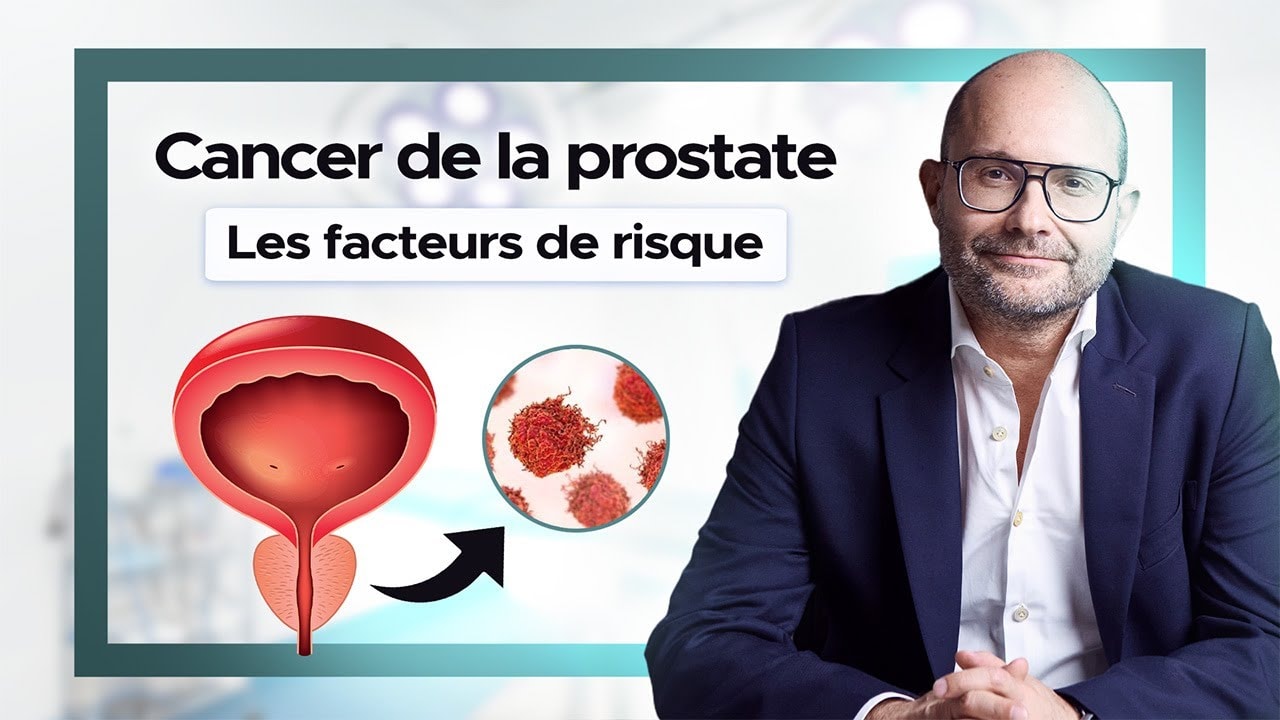
With approximately 50,000 new cases per year , prostate cancer is the most common cancer in men. It is therefore legitimate to ask a simple question: how can you tell if you are at risk ?
The answer lies in two key ideas. First, certain risk factors are well-identified . Second, unfortunately , no clearly proven protective factors have been identified to date. In other words, we cannot definitively prevent the onset of prostate cancer, but we can better identify men at higher risk and, above all , avoid missing an early diagnosis .
Proven risk factors for prostate cancer
Today, several factors are recognized as increasing the risk of developing prostate cancer.
Age: the primary risk factor
The main risk factor is age . Prostate cancer is primarily a cancer of men over 50 , although it can appear earlier in some cases.
This point is fundamental because it explains why vigilance increases with age. The older one gets, the more significant the risk becomes. This does not mean that every man over 50 will develop prostate cancer, but simply that age is the most common age group for its occurrence.
Heredity and genetics
The second major risk factor is heredity , in other words, the genetic component. When there is a family history of the condition, the level of vigilance must be higher.
This factor is important enough to be distinguished from others. It is not merely an impression or a vague association: genetics is among the known elements that make some men more susceptible than others.
Ethnic origin
The third recognized risk factor is ethnic origin . It is known that there is a higher incidence of prostate cancer in patients of Afro-Caribbean origin .
This finding is important in practice because it allows us to identify populations where increased attention is needed. It is not a matter of individual certainty, but rather a real statistical factor indicating increased risk.
The specific case of the Antilles and chlordecone
When discussing the risk of prostate cancer in men from the West Indies, one specific topic must be addressed: chlordecone .
Chlordecone is a pesticide used in banana plantations in various parts of the world, particularly in the Caribbean between 1972 and 1993. For approximately twenty years, this product caused lasting pollution.
- soils,
- rivers,
- and the nearby marine environment.
This pollution was not limited to a one-off exposure. It has left a lasting environmental footprint. This is what makes the issue particularly serious.
Today, chlordecone is recognized as a risk factor for prostate cancer . This recognition is such that, in affected patients, prostate cancer can be declared an occupational disease .
In other words, in this situation, the risk is not solely based on age or origin. There is also an identified environmental exposure, with now recognized health consequences.
The suspected factors, but not yet proven
Besides the clearly established risk factors, there are other elements that are suspected , although it cannot be said today that they cause prostate cancer.
The distinction is important. In medicine, it's necessary to differentiate between what is proven and what still needs to be confirmed.
High blood pressure and obesity
Suspected factors include:
- high blood pressure ,
- obesity .
At this stage, these elements cannot be presented as established causes. They are being studied, monitored, and discussed, but nothing has been formally proven within the framework presented here.
Therefore, two extremes must be avoided:
- to consider them as completely unimportant,
- or, on the contrary, present them as scientific certainties.
Testosterone: a topic that requires nuance
The issue of testosterone deserves a special explanation, as it is often a source of concern and confusion.
We know that prostate cancer is a hormone-dependent cancer. This means that it depends on the male hormone, testosterone. But this biological fact alone does not allow us to conclude that any increase in testosterone automatically leads to cancer.
We need to distinguish between two very different situations.
1. Testosterone deficiency treated to return to a normal level
In some patients, there is a testosterone deficiency , called hypoandrogenism . In this case, treatment can be offered to restore normal levels.
The message is clear: correcting a lack of testosterone to return to a normal level does not, in itself, give any more reason than any other to develop prostate cancer .
This clarification is important because many men mistakenly equate any testosterone prescription with an immediate danger to the prostate. That is not what is being said here.
2. The use of testosterone in a man who already has a normal level
The situation is different for men who initially have a normal level of testosterone but who take it anyway, for example for doping or performance reasons.
In this context, there is an overexposure to testosterone . And the real question is not necessarily whether this creates prostate cancer from scratch, but rather whether it can contribute to its earlier onset .
On this point, we cannot yet make a definitive decision . Uncertainty remains, but caution is advised.
What we don't yet know: no protective factors identified
One point deserves to be stated frankly: at present, no factor is known to protect against prostate cancer .
This is a significant limitation of current knowledge. We would like to be able to say that a behavior, a food, a habit, or a treatment clearly provides protection. This is not the case.
This lack of a known protective factor changes the logic of prevention. Since we cannot reliably prevent the onset of the disease, the objective becomes different: to detect it early enough .
Why early screening is essential
The most important message is not just to identify risk factors. It's to understand why early prostate screening is crucial.
Screening does not prevent cancer from developing. However, it helps avoid a much more problematic situation: discovering the disease too late .
The risk of a late diagnosis is that cancer may be discovered later:
- at an advanced stage ,
- at a metastatic stage ,
- at a stage where a cure can no longer be guaranteed.
That's the crux of the matter. When prostate cancer is identified early, the treatment is very different from that of a disease diagnosed late.
How can we concretely interpret our level of risk?
To put it simply, a man presents a more exposed profile if he combines one or more of the following elements:
- to be over 50 years old ,
- to have a compelling family history ,
- to be of Afro-Caribbean origin ,
- to have been exposed to chlordecone in the Caribbean context.
Other factors such as obesity , hypertension or overexposure to testosterone remain subjects of discussion and research, but should not be presented as formally established causes in the current state of affairs.
The key takeaway
Prostate cancer is common, but not all men are equally susceptible. Certain factors have been clearly identified:
- age,
- heredity,
- ethnic origin,
- and, in certain specific situations, exposure to chlordecone .
Other factors are merely suspected and should be interpreted with caution.
Finally, it's important to keep in mind a simple reality: we cannot currently prevent prostate cancer with certainty . However, we can prevent its discovery at a time when treatment options become more limited. This is why risk assessment and early detection remain central to the strategy.