
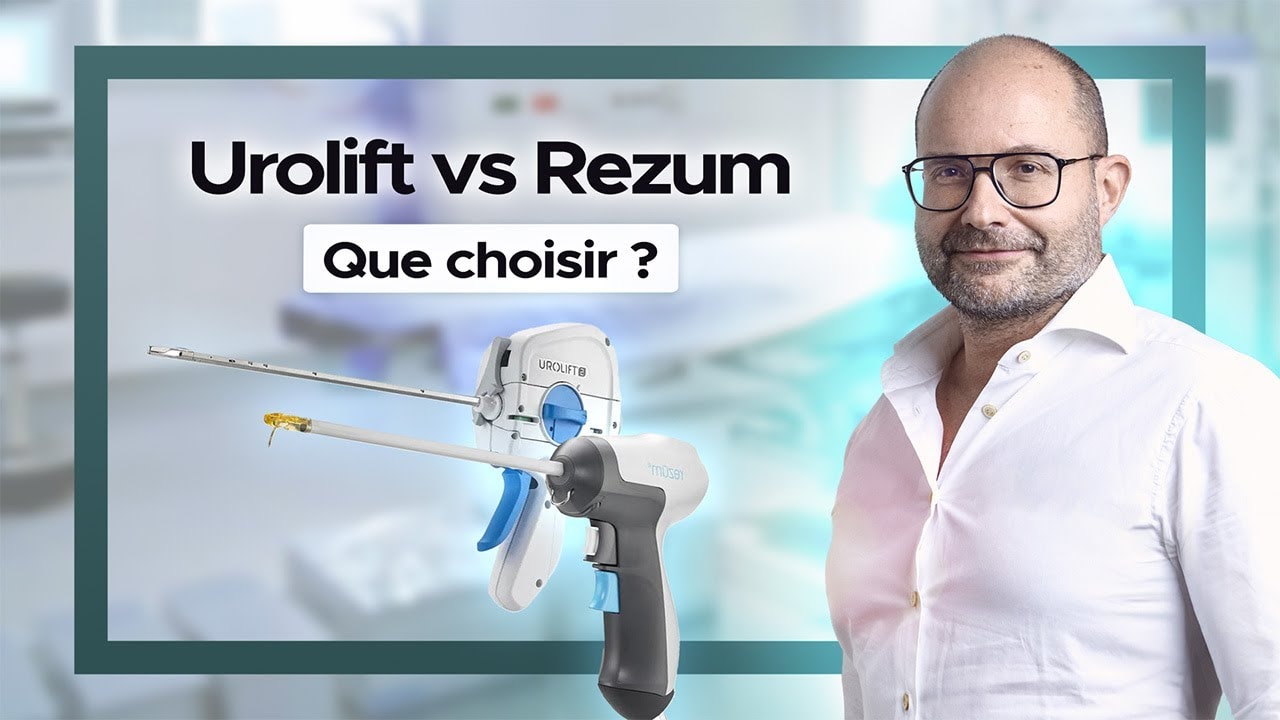
When suffering from a prostate adenoma, there often comes a point where medication is no longer sufficient or is poorly tolerated. At this stage, many men seek an effective solution, but without immediately resorting to traditional laser surgery or endoscopic resection, which involve removing the adenoma.
This is precisely where minimally invasive treatments like Urolift and Rezum come into their own. These are two recent, appealing, outpatient options, with generally simpler recovery periods than traditional techniques.
But between the two, how do you choose? The answer depends mainly on your priorities: avoiding a foreign body, avoiding a probe after the procedure, seeking a possibly more lasting effect, or preserving ejaculation as much as possible.
Two minimally invasive treatments to avoid traditional surgery
Urolift and Rezum have a common goal: to improve urinary symptoms related to benign prostatic hyperplasia without resorting to a more aggressive intervention right away.
In both cases, we are dealing with techniques:
- minimally invasive ,
- performed on an outpatient basis , with admission in the morning and discharge in the evening.
- performed under short general anesthesia , or sometimes under local anesthesia depending on the center,
- with less intensive after-effects than traditional adenoma surgery.
In other words, for a well-selected patient, these are two very good alternatives.
How does Rezum work?
The principle of Rezum is simple: water vapor is injected into the prostate via natural channels.
This steam will produce a targeted thermal effect that softens the prostatic tissue and reduces its volume . By reducing the obstruction created by the adenoma, the passage of urine is improved, thus enhancing the quality of the urinary stream.
The idea is therefore not to staple or remove the tissue immediately, but to cause a gradual reduction in the prostate volume.
How does the Urolift work?
Urolift relies on a different mechanism. Here, the prostatic tissue is not destroyed. Small staples or implants are placed inside the prostate which will separate the prostatic lobes to widen the urethra .
The goal is mechanical: to open the urinary canal from the inside so that urine flows better.
The desired result is the same as for Rezum, namely an improvement in urinary symptoms, but the method used is not at all the same.
What the two techniques have in common
Before discussing the differences, it’s important to highlight that Urolift and Rezum share several significant advantages:
- They often avoid more invasive surgery.
- They are performed without prolonged hospitalization.
- They are designed to offer easier retrieval.
- They seek to preserve ejaculatory function as much as possible , which is a major point for many patients.
In terms of overall effectiveness, the two techniques give fairly similar results .
Key differences between Urolift and Rezum
1. Foreign body or not
This is probably the most significant difference.
With Urolift , a permanent implant is left in the prostate. This is therefore a foreign body that will remain in place permanently.
With Rezum , there are no foreign bodies . Steam is simply injected into the prostate.
For some patients, this point is crucial. Some readily accept the idea of an internal implant. Others clearly prefer a technique that leaves no hardware in place.
2. The urinary catheter after the procedure
Another very concrete difference, and often a decisive factor in the choice.
After a Urolift , there is generally no need for a bladder catheter at the time of discharge.
After a Rezum , however, a urinary catheter is generally required for a few days .
For a patient who absolutely wants to avoid the probe, the Urolift may therefore seem more comfortable in the immediate future.
3. Discomfort related to the implant
With Urolift, the presence of the implant can sometimes cause perineal discomfort during the first few months.
It’s not always the case, but it’s something to be aware of before making a decision.
Rezum does not expose you to this type of discomfort associated with an implant, since nothing is left in the prostate.
What results can be expected?
In terms of symptom improvement, the two treatments are broadly comparable .
However, there is a trend in favor of Rezum on two points:
- The urinary stream sometimes seems a little stronger .
- the effect appears to be more lasting over time.
This difference is not presented as absolute, but it is important to consider, especially for patients who are looking for a minimally invasive solution with the best possible medium and long-term performance.
5-year reintervention rate
The most telling criterion for comparing durability is undoubtedly the risk of needing to be re-operated on.
- With Rezum , the 5-year reintervention rate is approximately 6% .
- With Urolift , it is approximately 12% .
In other words, there are half as many repeat interventions at 5 years with Rezum . This is a strong argument in its favor when the priority is the durability of the result.
The key point: preserving ejaculation
This is one of the major advantages of these two treatments. Unlike traditional surgery for adenomas, they minimize the risk of retrograde ejaculation .
Retrograde ejaculation occurs when semen is not normally expelled during orgasm, but instead flows back into the bladder. It is not dangerous, but it can be a very distressing experience.
With conventional adenoma surgery, this risk is extremely high, on the order of 99% to 100% .
With minimally invasive techniques, the logic changes completely:
- With Rezum , the risk of retrograde ejaculation is less than 5% .
- with Urolift , it is even lower, around 0.5% .
If preserving ejaculation is your top priority, Urolift has an advantage . If you accept a very low risk but might want a longer-lasting effect, Rezum could be a very suitable option .
For which patients are these treatments suitable?
There is an important limitation that must be known: Urolift and Rezum are reserved for prostates weighing less than approximately 70 grams .
When the prostate is too large, the risk of failure becomes very high. In this case, these techniques are generally not offered, as they are not suited to the morphology of the adenoma.
The choice of treatment therefore depends not only on your symptoms and expectations, but also on the size of your prostate .
How to choose between Urolift and Rezum?
In practice, things can be summarized as follows.
The Urolift may be a good option if:
- You wish to avoid a urinary catheter after the procedure,
- Maximum preservation of ejaculation is your priority.
- You accept the presence of a permanent implant in the prostate.
Rezum might be a good option if:
- You prefer a technique without foreign bodies .
- You might be looking for a slightly better urine stream .
- You are opting for a more lasting effect , with fewer repeat interventions after 5 years.
- You agree to have a probe inserted for a few days .
Key takeaways
Urolift and Rezum are two excellent minimally invasive treatments for prostate adenoma in well-selected patients.
Their effectiveness is similar, their implementation is simple in a hospital setting, and above all they allow for much better preservation of ejaculation than traditional surgery.
The real difference often comes down to four questions:
- Do you want to avoid a permanent implant?
- Are you prepared to keep a probe in for a few days?
- Are you primarily looking for sustainability?
- Is preserving ejaculation to the maximum your top priority?
Finally, it’s important to keep in mind that these techniques are not suitable for large prostates . The size of the gland remains a determining factor in determining the appropriate treatment.
The right choice is therefore not the same for everyone. It must be made with your urologist, depending on your prostate, your symptoms, your age, your expectations and your personal priorities.